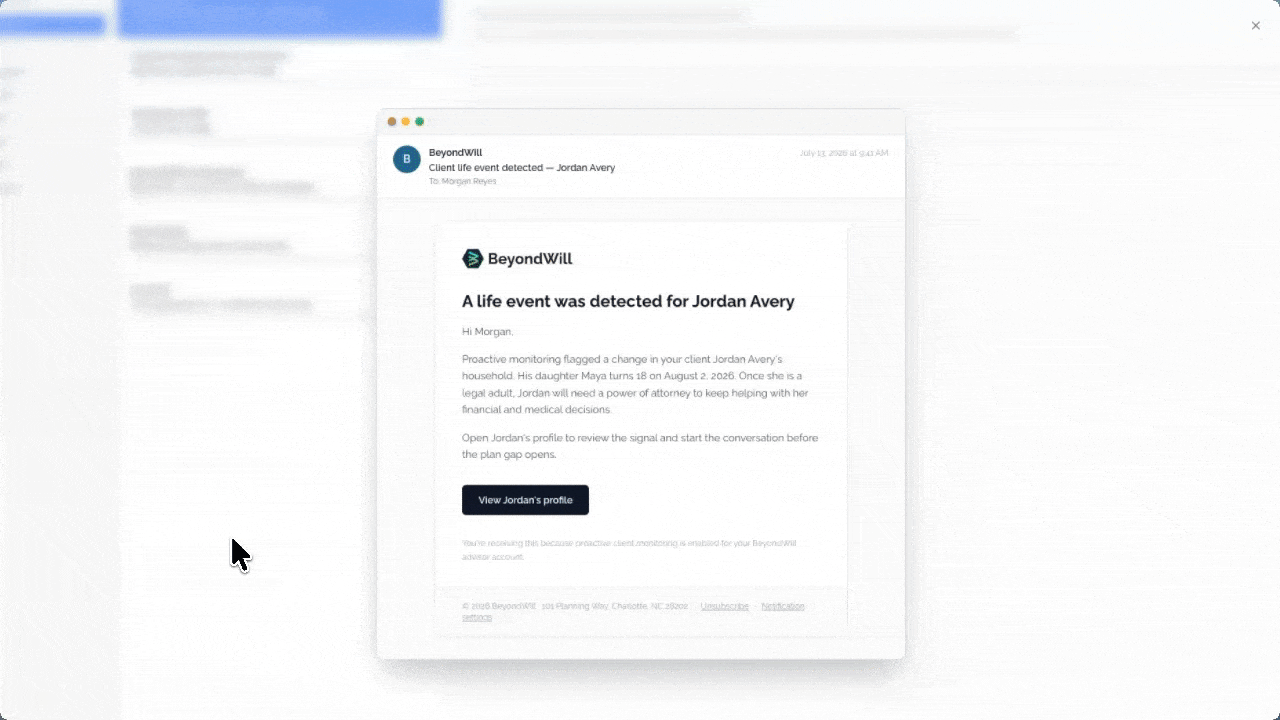
Most estate planning attorneys recommend reviewing your plan every three to five years, and immediately after any major life event. Life events that typically require an update include marriage, divorce, the birth or adoption of a child, the death of a named beneficiary or executor, a significant change in assets, moving to a new state, or changes in federal or state estate tax law. In practice, most Americans update their plans far less frequently than that. BeyondWill monitors plan data and prompts clients and their advisors when updates may be needed, so changes don't fall through the cracks.
Estate planning built for how people live
Simple for individuals. Powerful for advisors. Built to protect families over time.
AS SEEN IN
Estate plans shouldn’t expire when life changes
Traditional plans fade. BeyondWill keeps them living and evolving. When life changes, so should plans.
Plans that start faster, stay current, and mean more
Create plans
Revocable Trust & Pour Over Will, Last Will & Testatment, Financial Power of Attorney, Healthcare Power of Attorney, Living Will, Executor & Trustee Summary
Start your clients on second base
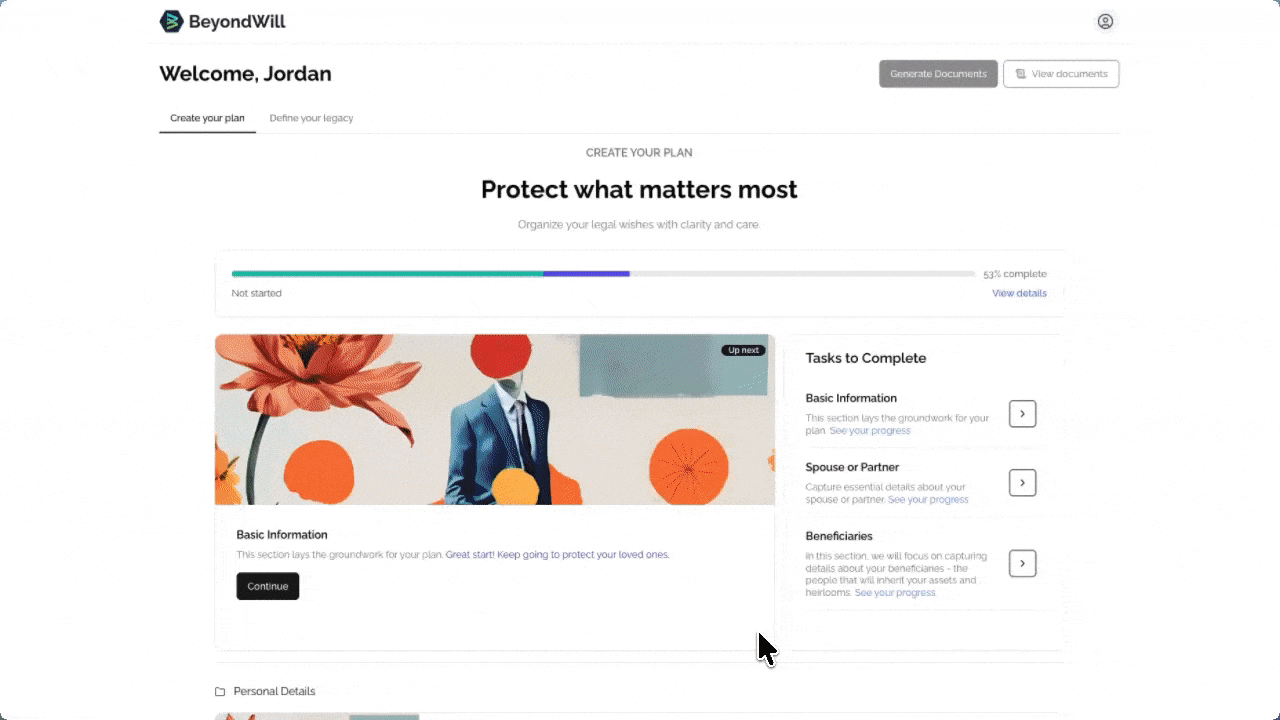
Upload documents or connect your CRM so clients begin their journey with half of their plan already created.
Proactive updates
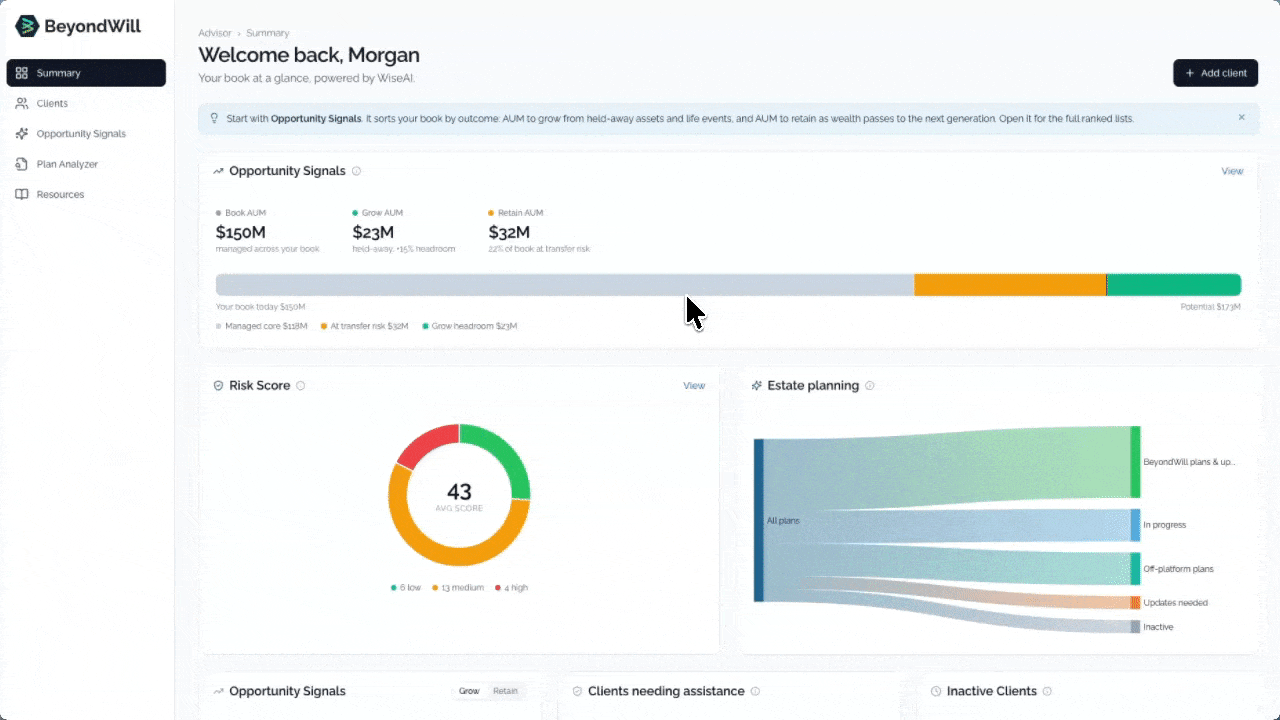
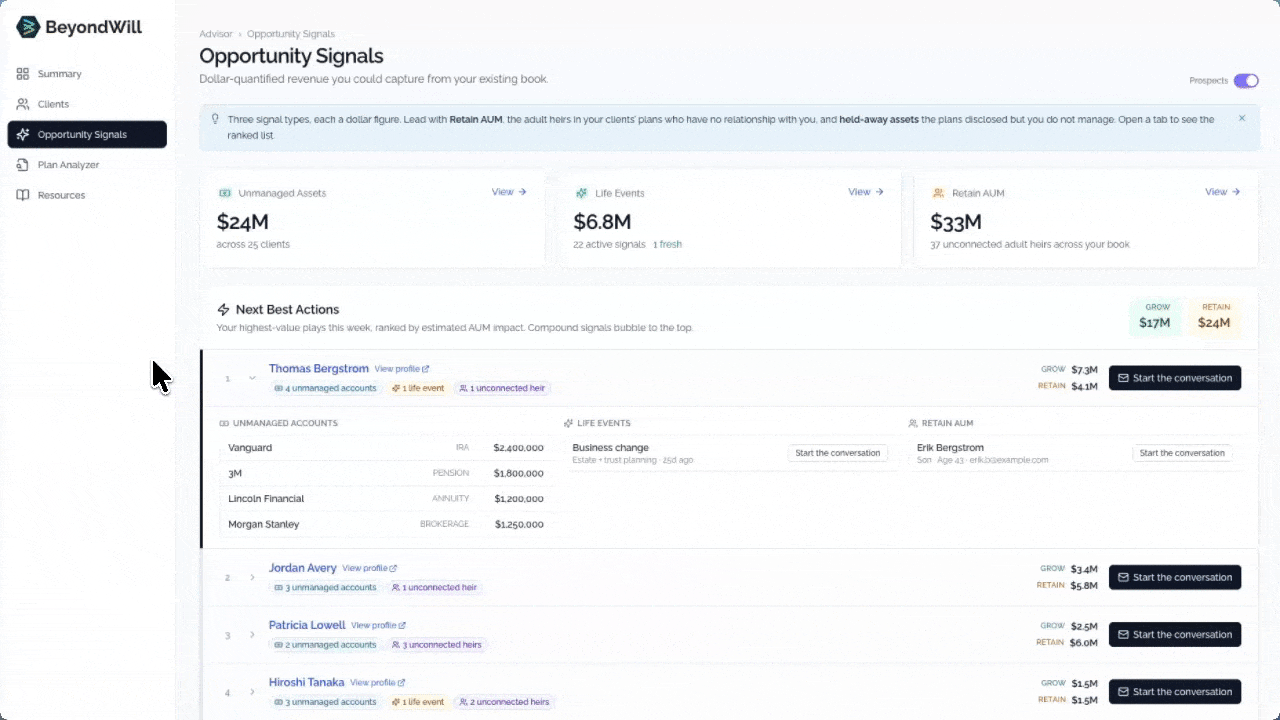
WiseAI™ monitors plan data and activity to spot changes before they become issues. Ask questions about any client’s plan, receive proactive alerts, and strengthen relationships through timely insights.
Client Insights from Legal to Legacy
Clients build their plans and also capture their legacy through stories, values, and traditions that define them, giving you a clearer view of their goals and legacy.
Planning that grows with your family
BeyondWill is a modern estate planning platform built on a simple belief: a plan that doesn't evolve with your life isn't really protecting your family. Most estate plans are created once, filed away, and forgotten, even as marriages, children, homes, and relationships change. BeyondWill changes that by combining guided document creation, AI-powered plan analysis, and life-event driven updates into one platform that keeps plans current over time. Financial advisors use BeyondWill to help clients create and maintain plans without the overhead of manual intake or document chasing. Individuals and families use it to build a complete legal plan and capture the stories and values that define their legacy, not just the assets they leave behind. All plan templates are drafted and reviewed by licensed estate attorneys and are available across 49 states and Washington D.C.
Be the hero your clients need
Help clients create and keep estate plans up to date, while capturing the human legacy behind the documents.
Explore advisor solutions
Streamline intake and handoffs
Get structured client information, reduce back and forth, and collaborate on edge cases that require customization.
Explore attorney solutions
Offer planning as a benefit
Give employees a modern way to create and update plans, with guidance that fits into real life.
Explore employer solutions
Protect who and what matters most
Create a plan that evolves with life, keeps everything organized, and helps you pass down more than assets.
Explore individual plans
"If you’re serious about providing complete financial advice, you need BeyondWill."
“BeyondWill lined up perfectly with the kind of proactive, family-first support I want my clients to feel.”
– Cory Sims, Managing Member, Sims Investment Management
– David McDaniel, III, Co-Founder & Wealth Strategist, 5thQtr Wealth
Help more families protect what truly matters
Frequently asked questions
Estate planning basics
How often should I update my estate plan? +
What is the difference between a will and a revocable trust? +
A last will and testament is a legal document that directs how your assets should be distributed after your death and names guardians for minor children. It takes effect only after death and typically must go through probate, the court-supervised process of validating the document and distributing assets. A revocable trust is a legal structure that holds assets during your lifetime and transfers them to beneficiaries after death, usually without going through probate. Because assets held in a revocable trust pass outside of probate, the transfer is typically faster, more private, and less expensive for your family. A revocable trust also allows you to plan for incapacity, not just death. Many estate plans include both a revocable trust and a "pour-over will" that directs any remaining assets into the trust at death.
What happens to my estate plan if I move to a new state? +
Estate planning law is governed at the state level, and while most states will recognize a will or trust that was validly executed in another state, moving creates real risks that are easy to overlook. Your chosen executor or trustee may not be eligible to serve in your new state. Witness and notarization requirements vary and could affect whether your documents are considered valid. Some states have community property rules that affect how assets are owned and distributed. Power of attorney forms can also be state-specific, and a document from your previous state may not be accepted by financial institutions or medical providers in your new state. After any interstate move, it's worth reviewing your plan with an attorney to confirm everything still holds.
What does financial power of attorney mean? +
A financial power of attorney is a legal document that authorizes someone, called your agent or attorney-in-fact, to manage financial decisions on your behalf. This can include accessing bank accounts, paying bills, managing investments, filing taxes, and handling real estate transactions. A durable financial power of attorney remains in effect even if you become incapacitated, which is why it's one of the most important documents in any estate plan. Without one, a court may need to appoint a guardian or conservator to manage your affairs if you're unable to, a process that is often slow, expensive, and public.
What is a living will? +
A living will, sometimes called an advance healthcare directive, is a legal document that records your wishes regarding medical treatment if you become unable to communicate those decisions yourself. It typically covers preferences around life-sustaining treatment, resuscitation, artificial nutrition, and palliative care. A living will works alongside a healthcare power of attorney, which names someone to make medical decisions on your behalf. Together, these documents ensure that medical providers and family members know your wishes and have the authority to carry them out, reducing the burden on loved ones during an already difficult time.
Your BeyondWill plan
What type of plans can I create on BeyondWill? +
BeyondWill supports simple will-based plans as well as trust-based plans built with attorney collaboration. Every plan includes guardianship, beneficiary designations, and digital asset coverage.
Is BeyondWill attorney-approved? +
All plan templates are drafted and reviewed by licensed estate attorneys to ensure compliance across 49 states and the District of Columbia. BeyondWill does not service Louisiana. Advisors can also collaborate directly with attorneys through BeyondWill's network when clients need more complex planning.
What documents are included in a BeyondWill estate plan? +
A complete BeyondWill estate plan can include a last will and testament, a revocable trust with pour-over will, a financial durable power of attorney, a healthcare power of attorney, a living will or advance directive, and an executor and trustee summary designed to guide family members through the administration process. Every document is drafted using attorney-reviewed templates and is available across 49 states and Washington D.C. BeyondWill does not currently service Louisiana.
Is online estate planning legally valid? +
Yes. Estate plans created through BeyondWill use attorney-reviewed legal templates and are valid when properly signed, witnessed, and notarized according to the requirements of your state. BeyondWill guides you through the signing process and explains the execution requirements for your state. The documents themselves carry the same legal weight as plans drafted directly by an attorney, provided they are executed correctly. For complex situations involving business interests, multi-state property, blended families, or significant tax planning needs, BeyondWill can connect you with an estate attorney in its network.
What happens to my estate plan on BeyondWill if I get divorced? +
Divorce is one of the most important triggers for updating an estate plan, and BeyondWill is designed to guide you through that process. A divorce may affect your named beneficiaries, healthcare and financial agents, guardianship designations, and how your assets are held or titled. Some states automatically revoke beneficiary designations to a former spouse upon divorce, while others do not. BeyondWill will prompt you to review and update affected sections of your plan following a divorce or separation so that your documents reflect your current wishes and family situation.
Who is the typical client using BeyondWill? +
The average client is around 44 years old, married or in a committed relationship, with kids, a home, and full-time employment. They're busy professionals who value efficiency, clarity, and the ability to keep their plan up to date.
Is BeyondWill only for high-net-worth clients? +
No. The platform was built for the mass affluent through high-net-worth individuals, anyone who wants a plan that evolves with life, not one that expires with it.
Build stronger relationships, one plan at a time
Practical ideas for helping clients protect what matters most and strengthen their legacies through collaboration.
PLATFORM
SOLUTIONS
COMPANY
© 2026 BeyondWill, 727 Madison Ave, Covington, KY 41011
BeyondWill Is not a law firm and does not provide legal advice.